
What exactly is leadership? What is the beginning of the leadership? What is a rhetorical triangle? Why is it significant to know oneself? How do you get to know yourself?
Have you ever imagined yourself as a leader? Or are you already one of them? So what is a leader?

Let's first acknowledge what leadership is.
About 2300 years ago, a man marched his troops through the dry, desolate, and scorching hot desert. Because of their thirst, some infantrymen decided to go and search for water. They searched and searched and they finally came upon a small ravine of refreshing water. One of the soldiers excitedly began to scoop up the water and rush it back to their commander. But when he saw his men coming, he only had one concern, quenching the spirit of his troops. When they handed him the helmet, he took the helmet and said thank you, showing true appreciation for the water. So he held it up in full view of everyone watching and did the unimaginable, which is, he turned it upside down, spilling the water on the ground. The message was clear that if his troop did not have anything to drink neither would he. This demonstration of leadership earned him the title "Alexander the Great". Not because he could create empires, conquer nations, or defeat armies. he became great because he was able to conquer himself within. What he understood so profoundly is that leaders are not great because they have power. Leaders are great because they can empower others. Understanding this truth was one of his great victories. He was able to inspire optimism when he sensed despair. He was able to encourage achievement when he witnessed a difficulty. Great leaders make us feel the same way they do. They give us the impression that we are capable of doing the inconceivable. That is why, when we think of leadership, we frequently think of adoring crowds and believe it is an outward attribute. However, leadership has always been and will always be an inside trait that must be developed to lead outwardly. This is where true leadership comes to appear.
Mastering others is strength; mastering oneself is true power.- Lao Tsu
Does leadership begin with knowing who you are?
The majority of individuals desire to know the answers to the queries of how, where, when, and even why they should be great leaders. They are, however, overlooking the most essential topic of all. What exactly am I? What exactly do I stand for? What am I willing to sacrifice for? When you can answer the question of who you are, you begin to understand yourself, and when you understand yourself, you grow for yourself. As a result, your GPS will always guide you.
Knowing yourself is the beginning of all wisdom.- Aristotle
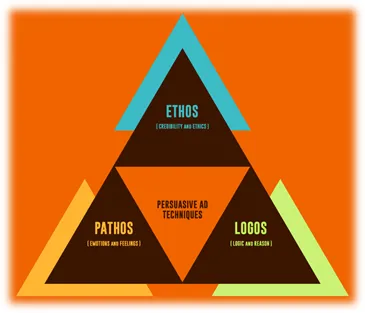
Here's a rhetorical triangle that encompasses three key concepts: the compass of life.
The first concept is ETHOS.
To begin with, being ethical provides you with a priceless reputation in both work and personal life. Most importantly, you must be human, happy, and fulfilled. Because we despise hypocrites, liars, and deception. Why do we want to be that way? We can never be content. Ethos should be the primary filter for all decisions, no matter how big or little. So, before making a decision, ask yourself, "Does this align with my values?" Get used to asking this.
The second concept is PATHOS.
The second filter in your decision-making process is pathos. What are your thoughts on the decision? What does your heart say? What are your feelings? This is also known as emotion control because someone who has learned to manage his emotions can quickly identify the emotions of others and use them to his advantage in any scenario.
The last concept is the LOGO.
Logos is the ultimate decision-making filter. It combines logical reasoning with coherence and cohesion. Real arguments, facts, and, most importantly, a strategy will be required while making a decision. So it is important to make these questions clear. Is this a scientific or factual decision? Is your objective crystal clear?
Living morally, directing our chaos, and thinking logically are the rewards we make for ourselves.

Now let’s understand why it is important to know you from within with a short history.
When a wise man was on his deathbed, he was overwhelmed with immense concern and suffering. When his students realized how stressed their beloved one was, they attempted to calm him down and told him, "You were almost as nice as Abraham and almost as intelligent as Moses." You have nothing to be concerned about. The guy glanced at his students and said, "That won't matter, and when I go to heaven, they are not going to ask why I was like Abraham and why I was like Moses." They're going to ask me why I wasn't more like myself.
How do you get to know yourself?
It all starts with committing to listen to your heart and comprehend your spirit, but what does that entail? That implies we must examine all of the key decisions we have made in our life. Why did we create them? What ideas influenced such choices? So that we can acknowledge both the good and the bad. We can acknowledge both our accomplishments and our flaws since none of us are flawless. Those who have been strong in adversity can teach each of us to be strong in adversity, those who have been calm in a storm can teach us to remain calm in a storm, and those who have been able to embrace their shadows can teach us to embrace all of who we are.
Leadership is not an abstract, obscure, godlike skill that is only for the few of us. leadership exists in each one of you.
Source:
(Great leadership starts with self-leadership | Lars Sudmann | TEDxUCLouvain 2016)
(We Cannot Lead Others Without First Leading From Within | Lolly Daskal | TEDxLincolnSquare 2018)
(Self Leadership - The 3 Golden Principles of Greek Philosophy | Alkistis Agio | TEDxIMIB 2020)